
In this guide
You can generate a fashion image without creating an influencer.
This guide uses the established search term “AI influencer.” LookSky calls the long-term, brand-managed version a virtual influencer.
An influencer needs more than a good photograph. It needs a recognizable identity, a distinct point of view and a reason for people to keep paying attention. For a fashion brand, that identity also needs to work across different products, collections and marketing moments.
For a small or midsize fashion brand with lean teams and limited budgets, the challenge is making those pieces work together without creating another operation your team cannot maintain.
To create an AI influencer for your fashion brand, start with the brand’s positioning, develop a consistent character, plan content around your products, establish a production and publishing workflow, then use audience response to improve. The goal is a dedicated, long-term brand asset—not a new face for every campaign.
At LookSky, that character operates on separate, brand-owned secondary accounts. Your team continues to manage the primary brand channels and human-influencer relationships. The AI ambassador adds another way for people to discover your products, with LookSky handling its ongoing operation.
Here is what the process involves.
Analyze Your Brand.
Find Its Edge.
- Your role
- Provide product assets, brand guidelines, target markets and business goals.
- LookSky handles
- Analyze brand positioning, target audiences, competitor performance and differentiation opportunities.
- Deliverable
- Brand assessment, differentiation direction and a clear marketing role for the AI influencer.
Define the Positioning.
Build the Influencer Persona.
- Your role
- Approve the AI influencer’s look, persona and brand guardrails.
- LookSky handles
- Design the persona and complete cross-platform account setup, visual consistency and launch preparation.
- Deliverable
- An approved AI influencer persona and launch-ready social accounts.
Plan Content &
Product Strategy.
- LookSky handles
- Use trends, campaign moments and product performance to plan topics, scripts and creative angles.
- Deliverable
- A content and product strategy covering priority products, topics, scripts and creative directions.
Produce, Publish
& Promote.
- LookSky handles
- Produce and review images, videos and captions, then handle publishing, engagement and amplification.
- Deliverable
- 30 posts per platform each month, including images, videos, captions and source assets.
Validate. Optimize.
Repeat.
- LookSky handles
- Track views, engagement, follower growth, site visits and conversions, then analyze and optimize performance.
- Deliverable
- A performance report with recommendations for the next product, content, publishing and promotion cycle.
1. Analyze your brand. Find its edge.
Before choosing a face, decide what the character should help your brand communicate.
A contemporary tailoring label, an occasionwear brand and a menswear business may all want more visibility. But they need different personalities, styling choices and content.
“An attractive model wearing our clothes” is not enough direction. It leaves the creative team guessing about the audience, the character’s role and what makes the account worth following.
Start with a short brand brief that answers:
- Who are we trying to reach? Describe the customer’s interests, shopping context and wardrobe needs.
- What makes our products distinctive? Identify the design details, styling perspective or product strengths worth showing.
- Where does our existing content fall short? Perhaps the primary account covers launches well but has limited room for recurring styling stories.
- What role should the AI ambassador play? Give the character a clear contribution alongside your existing channels.
For example, a contemporary womenswear brand might develop an ambassador whose content explores how tailored pieces work across different occasions. The account could show styling combinations and collection details rather than simply repeating the brand’s product announcements.
This is an illustrative direction, not a formula every brand should copy. The right role comes from your products and audience.
Review competitors, too. Look at the subjects they cover, the visual language they use and the questions their audiences ask. Use that research to identify an opportunity—not to reproduce another brand’s character.
What you should have before moving on: a clear audience, a distinctive role and a practical reason for the account to exist.
2. Define the positioning. Build the persona.
Once the role is clear, develop the character around it.
The persona should be specific enough to recognize but flexible enough to work beyond one collection. Think about how the same identity will carry a new product launch, a seasonal styling story and a quieter week between campaigns.
Document the essentials:
- Appearance: Facial features, hairstyle, adult age range and consistent physical proportions.
- Fashion perspective: The silhouettes, styling choices and occasions that fit the character.
- Personality and voice: How the character communicates, including language, tone and expressions to avoid.
- Content boundaries: Subjects the account covers and claims it should not make.
- Brand relationship: How the character is identified as an AI-generated ambassador for your brand.
A fictional persona does not need a complicated invented life. A clear fashion perspective is more useful than a biography that encourages misleading claims about real experiences.
Create a reference set, not just one portrait
The first image is a candidate, not the finished identity.
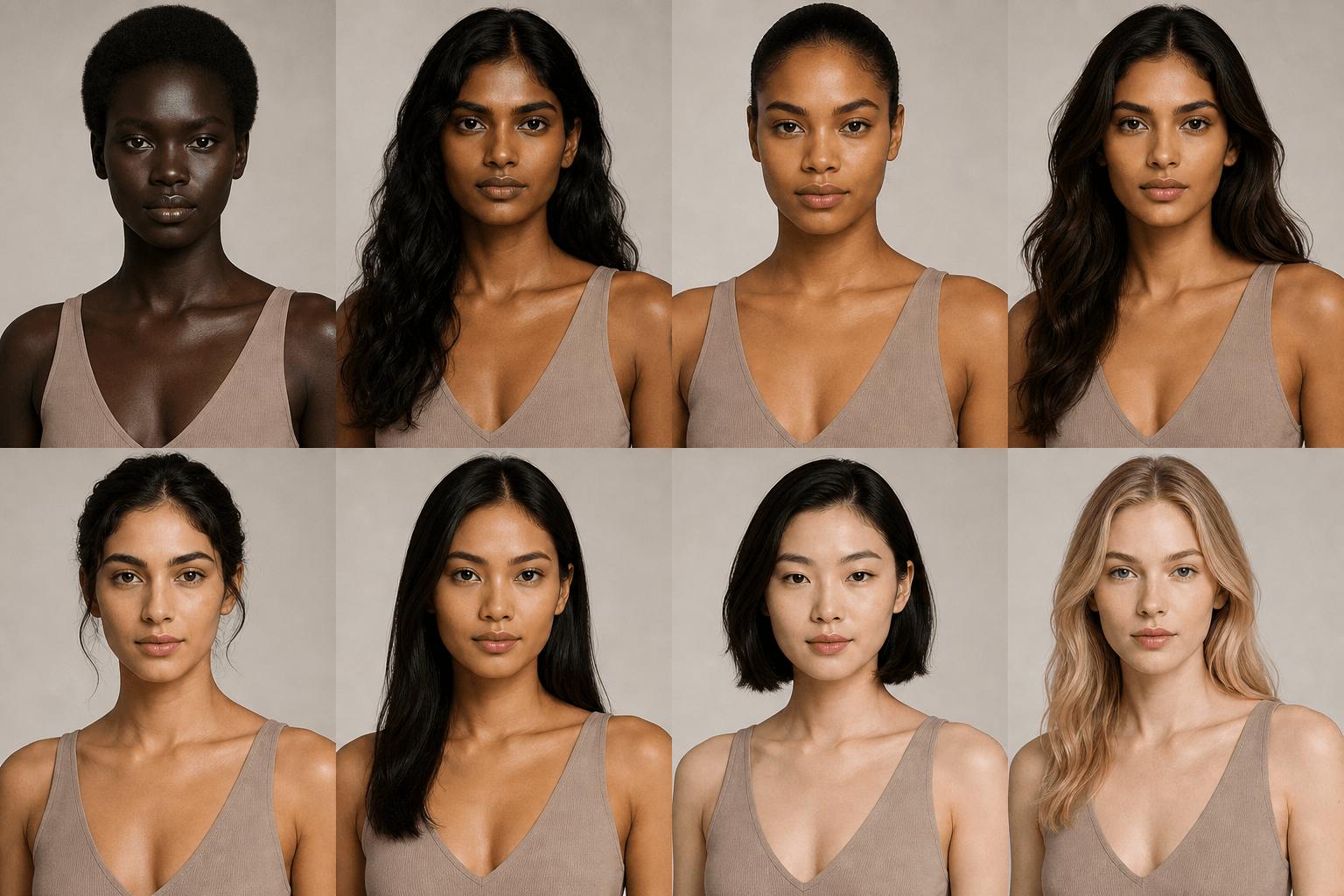
Use your chosen image-generation workflow to explore the character, then select an approved appearance. Build a reference set that shows the same person from different angles and at different distances: a face portrait, a three-quarter view and a wider fashion image.
A starting creative brief might read:
Create an original adult fashion persona for a contemporary tailoring brand. Use natural facial detail, believable body proportions and understated styling. Begin with a simple studio portrait so the face and hairstyle can be reviewed clearly.
That is only an initial direction. A text prompt alone is not a complete identity system.
Once you approve the character, use the reference features available in your production tools and review subsequent outputs against the approved set. Test the identity in different lighting, poses and outfits before committing to a full content schedule.
Watch for changes in facial structure, apparent age, hairstyle and proportions. A character that looks consistent in two close-up portraits may look different in a full-length image or movement sequence.
Keep the approved references together with the persona brief. They should guide future production, whoever is doing the work.
Give the character its own account identity
Under LookSky’s model, the AI ambassador has separate, brand-owned secondary accounts.
Your primary accounts remain the home for the brand’s existing content, launches and human-influencer partnerships. The secondary accounts give the character a distinct voice and recurring content direction.
Document account ownership, access and recovery arrangements from the beginning. The character’s name, account presentation and relationship to the brand should also be clear.
What you should have before moving on: an approved persona, a usable visual reference set and an account identity designed for long-term use.
3. Plan content and product strategy.
A character becomes useful when there is a repeatable plan for what it will publish.
Start with the products you want to support and the questions the content should answer. Then decide which creative formats can communicate those ideas.
For a fashion brand, useful content directions might include:
- Styling combinations: Show how pieces work together or how one garment changes with different accessories.
- Occasion-led looks: Present outfits around a relevant setting, season or dressing need.
- Product details: Draw attention to construction, embellishment, texture or a distinctive silhouette.
- Collection stories: Connect individual products through a consistent fashion point of view.
These are starting points, not a requirement to use every format.
Choose a manageable set that fits the character and gives you something meaningful to test. Repeating a useful format with different products can teach you more than producing unrelated ideas with no consistent direction.
Turn each idea into a production brief
A content calendar needs more than a date and “post about the new collection.”
Each brief should identify:
- The product and approved reference assets.
- The audience question or creative idea.
- The format, setting and styling.
- The product details that must remain accurate.
- The caption direction and intended next action.
- The person responsible for approval.
For example, a styling brief could ask the same character to present one jacket in two outfit combinations. The production team would need the jacket’s front and back views, detail photographs, color information and the intended styling direction.
Product priorities matter, too. Avoid building a large amount of content around an item that will not be available when the posts run.
The AI ambassador’s account should also offer something beyond a duplicate of the primary feed. Coordinate the two, but give the secondary account its own reason to be followed.
What you should have before moving on: a focused content plan with clear product priorities and briefs that can actually be produced.
4. Produce, publish and promote.
This is where the character, product references and content plan become finished work.
A practical workflow moves from briefing to generation, editing, quality review, approval and publishing. Assign responsibility for each stage before increasing the volume.
For lean teams, unclear handoffs are a particular problem. If nobody owns product corrections or final approval, unfinished assets can accumulate even when image generation is fast.
Review the garment as carefully as the face
A convincing image is not necessarily an accurate product image.
Check garment length, embellished details, neckline, hemline, seams, color and fabric appearance against the actual product. Review prints, closures and other distinctive features where relevant.
Then check the character’s face, body proportions, hands and pose. For video, review the sequence rather than approving it from a single frame.
If a garment’s details cannot be represented reliably, revise the asset, simplify the concept or choose a different treatment. A dramatic visual should not take priority over an accurate product.
The review also needs to cover the final format. Make sure the platform crop does not cut off the model’s head, hide the garment detail or remove important disclosure text.
Keep the fictional identity transparent
Make it clear that the character is AI-generated and connected to your brand.
AI labeling and advertising disclosure serve different purposes. A label explaining that an image is synthetic does not necessarily explain the account’s commercial relationship.
Meta describes using technical signals and uploader disclosures to label AI-generated content. Check the current labeling process for each platform you use. Meta’s explanation of AI-content labeling.
For marketing directed at U.S. consumers, the FTC says material brand relationships should be disclosed clearly with the endorsement; a profile-only disclosure may be missed. Build those checks into the publishing workflow and review the requirements for your markets. FTC disclosure guidance.
Avoid fabricated personal testimonials, too. A fictional character should not claim to have worn a dress to a real event or personally tested its comfort. Focus on styling ideas and supported product information instead of invented lived experience. FTC guidance on truthful endorsements.
Plan the work after publication
Publishing is not the end of the process.
Someone still needs to monitor comments, maintain product links, handle account activity and identify questions that should be passed to the brand’s team. Product availability, sizing and customer-service answers should come from approved information—not improvised responses.
Promotion should also have a clear purpose. If you choose to boost content, agree on the advertising budget and what you want to learn or achieve. Optional ad boosting is additional to LookSky’s agreed managed service.
What you should have before moving on: approved content, a reliable publishing workflow and clear ownership of the secondary accounts’ day-to-day activity.
5. Validate. Optimize. Repeat.
Once content is running, use the response to decide what to do next.
Do not reduce the review to whether a post received a large number of views. Different measures answer different questions.
- Views help you understand how widely content was shown or watched, according to the platform’s definition.
- Engagement helps you identify which ideas prompted interaction.
- Follower growth shows whether the account is building an ongoing audience.
- Tracked website visits help connect social activity with store discovery.
- Conversions, where measurement is available, provide a separate view of business outcomes.
Keep organic and paid activity distinguishable. Do not treat aggregate views as unique people, or assume that attention automatically produced sales.
Look for patterns across products, creative ideas and formats. A useful review should lead to a specific next decision: repeat a styling concept, adjust the opening of a video, change a product priority or clarify the next action.
Keep the character recognizable while testing the content around it. If you change the face, voice, product and format at the same time, it becomes harder to understand what affected the response.
Allow time for the account to develop
LookSky recommends allowing at least three months to develop the AI influencer, build traffic and give the program room to gain momentum.
That is a recommendation, not a fixed minimum engagement term or a guarantee of results.
The character is intended to become a long-term brand asset. Its value depends on an ongoing process of producing, publishing, learning and improving—not simply completing the first batch of images.
What your team needs to prepare
You do not need to arrive with a finished character concept. You do need to provide the information that keeps the work grounded in your brand.
A useful starting pack includes:
- Brand guidelines and examples of approved creative.
- Target audience and key markets.
- Product photographs, detail references and accurate descriptions.
- Priority products, upcoming launches and availability information.
- A nominated reviewer who can approve completed work.
- Clear boundaries around product claims, tone and brand presentation.
The better the inputs, the clearer the production brief and review process can be.
Comparing tools with managed support? Read our agency-versus-generator guide.
Real LookSky examples
See the influencers in motion.
Your AI ambassador. Managed by LookSky.
A dedicated, brand-owned presence on secondary accounts. You set the direction and approve the work. We handle the rest.
Book a demoRelated reading
Frequently asked questions
What do I need to create an AI influencer?
You need a clear brand role, a defined persona, consistent visual references, accurate product assets and a plan for production, publishing and account management. Image-generation software supports part of that process; people still need to direct, review and operate the work.
How do you keep an AI influencer looking consistent?
Start with an approved character reference set and a documented persona. Use those references throughout production and compare new images and videos against them. Review the face, hairstyle, apparent age and body proportions across different poses, outfits and settings—not just individual portraits.
Can an AI influencer wear our real products?
Yes, but the output needs product-specific review. Supply clear garment references and check length, embellished details, neckline, hemline, seams, color and fabric appearance. Generated imagery should not be treated as proof of real-world fit or comfort.
Does the AI influencer use our primary brand account?
Not under LookSky’s managed model. The AI ambassador operates on separate, brand-owned secondary accounts. Your team continues to run the primary brand accounts and existing human-influencer relationships.
Is the character created for one campaign?
LookSky develops dedicated characters intended for long-term use. Their identity stays recognizable while products, collections and content ideas evolve. They are not designed as disposable, campaign-only personas.
How long should we allow for the program?
LookSky recommends at least three months to develop the influencer, build traffic and give the program room to gain momentum. There is no fixed minimum engagement term, and the recommendation is not a promise of followers, traffic or sales.